Product quality, production efficiency and supply chain stability are closely related to the selection of suitable processing and manufacturing partners for production enterprises.

In the past, enterprises would choose different suppliers to complete each processing link. This traditional cooperation mode will bring many extra problems. It increases the difficulty of work coordination and corporate operating costs, and also extends the overall production cycle of products.

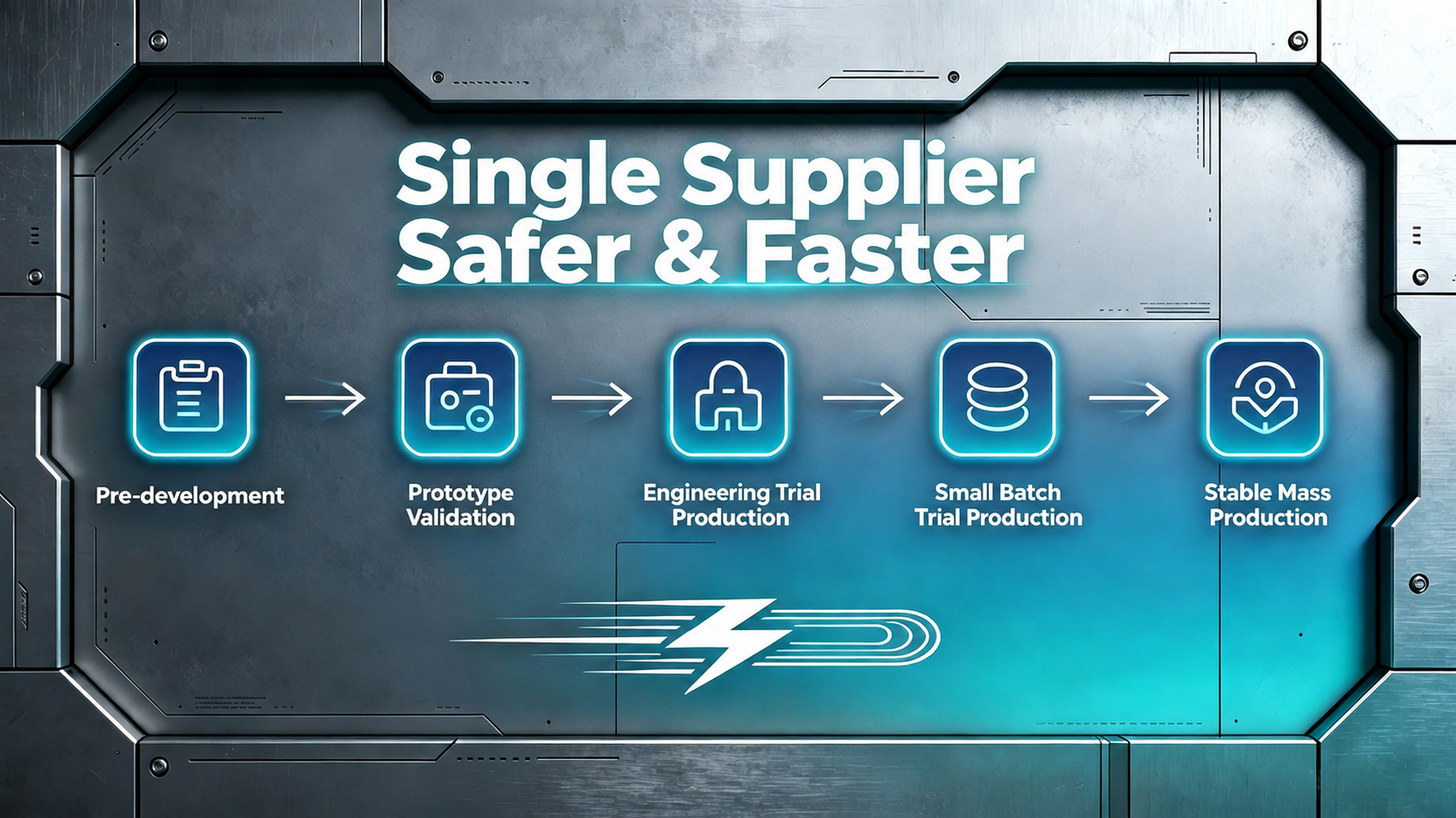
The global manufacturing industry is facing increasingly fierce market competition, driven by rising emerging manufacturers and oversupply of industrial products. More and more original equipment manufacturers (OEMs) begin to adopt the single-supplier cooperation mode for metal part processing. Enterprises only cooperate with one professional manufacturer. This single manufacturer can complete the whole production process independently, from early engineering evaluation and prototype development to later finished product assembly and performance testing.

The reason is that single-source production and processing modes have the following practical advantages for manufacturing enterprises:

  • Reduced communication complexity
  • Better quality consistency
  • Faster engineering changes
  • Lower total manufacturing costs
  • Improved delivery reliability

KingStar Mold provides integrated production and processing solutions for enterprises that need high-precision metal parts and assembled products. Through our sheet metal fabrication services, we integrate multiple sheet metal processing technologies, including laser cutting, bending, welding, surface finishing, precision detection, and product assembly. It can provide processing support for customers’ projects from prototype trial production to mass formal production.

This paper mainly analyzes the advantages of single-supplier cooperation mode in laser cutting, metal forming, and product assembly. The following research results we offer can help OEMs simplify procurement work, optimize product quality, and build a more efficient manufacturing supply chain system.

Why Should You Choose a Single Supplier for Metal Fabrication Instead of Multiple Vendors?

What Problems Do Multiple Fabrication Suppliers Create?

A typical multi-supplier workflow may look like:

  • Raw Material

  • Laser Cutting Supplier

  • Transportation

  • Forming Supplier

  • Welding Supplier

  • Assembly Supplier

  • Final Inspection

  • Customer

Each cooperative supplier has professional advantages in its own processing field. However, each additional transportation and processing link will bring uncertain risks to product production:

  • Longer production cycles
  • More transportation costs
  • Different quality standards
  • Difficult engineering communication
  • Increased inventory requirements
  • Unclear responsibility when problems occur

For instance, if the final assembled shell has position deviation and assembly errors, enterprises cannot quickly confirm the cause of the problem. The error may come from laser cutting deviation, bending forming errors, welding deformation or improper assembly operation.

The single-supplier cooperation mode can well solve the above communication and responsibility division problems. All product processing links are completed in the internal system of one manufacturer, and the whole production process can be effectively controlled.

How Does a Single Supplier Simplify Project Management?

Enterprises only need to connect with one engineering and production team after choosing an integrated processing supplier. This mode avoids the complex coordination work between multiple independent enterprises, and greatly simplifies the daily management of processing projects.

Centralized Engineering Communication

Product development and trial production stages often need repeated engineering adjustments. Enterprises may need to modify the hole position, bending angle and installation structure of parts according to prototype test results.
Enterprises need to send modification information to all suppliers one by one under the multi-supplier cooperation mode. This operation mode is prone to problems such as outdated design drawings and inconsistent modification effects of different links.

Improved Design for Manufacturability (DFM)

The single supplier can realize centralized management of engineering work. The unified management mode ensures that:
  • all departments obtain the latest modified drawings
  • the production procedures are consistent with the latest design scheme
  • the product inspection standards remain unified
  • all staff clearly understand the assembly technical requirements
KingStarMold provides professional design support services for customers. We carry out engineering evaluation and manufacturability analysis before formal production. We can help customers optimize product design schemes in advance and reduce subsequent modification costs.

Which Projects Benefit Most from a Single Fabrication Supplier?

The single-source processing mode is more suitable for product projects with complex processing procedures and strict quality inspection standards. This cooperation mode can exert the maximum value in such projects.

From our experience, typical products include:

IndustryTypical ComponentsMain Benefit
Industrial EquipmentFrames, brackets, cabinetsBetter process coordination
ElectronicsEnclosures and chassisImproved assembly accuracy
AutomationMachine structuresFaster engineering changes
Medical EquipmentPrecision housingsBetter traceability
EV SystemsBattery and charging enclosuresReduced supply chain risk

For these applications, the integrated single supplier can form a complete processing chain from design confirmation to finished product delivery, and make the whole project process more smooth.

How Does Integrated Laser Cutting, Forming, and Assembly Improve Product Quality?

Most quality defects in sheet metal manufacturing do not stem from a single independent production process. If different suppliers undertake these separate processing procedures, their equipment calibration standards, detection specifications and process management methods will exist certain differences. These accumulated differences will finally affect the overall use performance of finished products.

How Does One Manufacturing Workflow Reduce Tolerance Stack-Up?

Tolerance stack-up refers to the phenomenon that small dimensional deviations generated in different manufacturing processes overlap with each other. This superposition effect will lead to large-scale dimensional errors in finished assembled products. Each independent processing link may meet the specified tolerance range in actual production. However, the accumulated tiny deviations will cause many problems in the assembly stage. Common problems include part misalignment, uneven assembly gaps, unstable fastening effect and extra manual adjustment work.
The production of sheet metal enclosures can serve as a typical example of tolerance stack-up. The laser cutting process determines the specific positions of mounting holes, assembly grooves and plate edges on workpieces. In the subsequent bending process, changes in material thickness, bending angle and stamping pressure will slightly alter the overall shape and size of parts. The welding process will also produce new dimensional deviations. The heat generated during welding will easily cause local deformation and shrinkage of metal materials near the welding area.
Products will face higher quality risks if their parts are manufactured by different production systems. The subtle differences in process parameters among different suppliers will directly influence the assembly matching degree of various components. For example, the hole diameter of a mounting support may fully meet the design standard. But a tiny offset of the hole position will lead to unqualified assembly results. Workers need to carry out manual modification on site, and some products will even fail to reach the design requirements.
The single-supplier integrated production mode can effectively avoid the above risks. Enterprises will detect and control the dimensional accuracy of products from the initial laser cutting stage to the final assembly link. This real-time monitoring mode can help staff find tiny dimensional deviations in advance and prevent unqualified products from entering the final finished product link.

How Do GD&T and CMM Inspection Improve Dimensional Accuracy?

The dimensional accuracy control of precision sheet metal processing is not limited to the basic size detection of parts. Some workpieces may meet the basic size standards after processing, but they still cannot complete normal assembly. The main reason for this problem is that the spatial positional relationship of key structural features does not conform to the design requirements. Therefore, most manufacturers adopt the Geometric Dimensioning and Tolerancing (GD&T) system which is formulated based on industry standards such as ASME Y14.5.
The GD&T system can accurately control the functional matching relationship of key product structures. Its main control contents include the following items:
  • Positioning accuracy of mounting holes and fastening structures
  • Flatness of product matching contact surfaces
  • Parallelism between different structural edges of parts
  • Perpendicularity of bent and formed plate parts
  • Profile accuracy of special-shaped complex surfaces
In the processing of electronic equipment enclosures, for instance, the diameter of reserved mounting holes may fully comply with design standards. But the offset of hole positions will cause installation failures. Internal components such as circuit boards and fixed supports cannot be accurately aligned and assembled. The GD&T system takes the actual use function of finished products as the core standard. It realizes the precise control of key structural features, instead of only detecting the single size of independent parts.
Enterprises usually use Coordinate Measuring Machines (CMMs) to complete high-precision detection work, so as to verify whether products meet the GD&T standard requirements. Different from traditional manual detection methods, CMM equipment can collect three-dimensional coordinate data of the whole workpiece. It can compare the actual processing size data with the digital engineering drawings of products.
The application of CMM detection technology can bring multiple quality control advantages for manufacturers:
  • Realize accurate detection of complex workpiece shapes and key dimensional data
  • Ensure consistent and repeatable detection results of different production batches
  • Form complete digital detection files to facilitate product quality traceability
  • Find dimensional deviation problems in advance before product assembly operation
Many enterprises are engaged in the processing and production of precision metal enclosures, industrial equipment shells and customized sheet metal parts. The combined application of GD&T standards and CMM detection technology can build a more perfect quality control system. KingStar Mold has equipped professional precision detection equipment in the sheet metal processing process. The enterprise also formulates standardized and complete quality inspection procedures. These measures can maintain stable dimensional accuracy in mass production and ensure the overall qualified quality of manufactured products.

How Does Integrated Quality Control Prevent Manufacturing Defects?

Eligible metal product suppliers cannot rely only on final finished product inspection to control quality. Comprehensive quality supervision needs to run through the whole production and processing process.
The multi-supplier cooperation mode will lead to fragmented quality management work since different suppliers have different detection methods, record systems, and qualification judgment standards. This greatly impairs the probability of inconsistent product quality.
In the case of multiple suppliers, quality management becomes fragmented.
An integrated supplier, however, can establish a unified quality process covering:
  • Material verification
  • Laser cutting inspection
  • Forming accuracy checks
  • Welding quality control
  • Assembly verification
  • Final dimensional inspection
The full-process quality control can reveal potential product problems in the early processing stage. It can greatly reduce the scrap rate of products, avoid rework operations, and prevent production cycle delays.

Why Are FAI and Process Control Important for Production Reliability?

For prototyping and the subsequent new product launches, First Article Inspection (FAI) is often used to verify if the new design fully meets the engineering design requirements.
A typical FAI process covers:
  • Dimensional accuracy
  • Drawing scheme verification
  • Raw material qualification
  • Surface effect
  • Functional detection
After the start of mass production, manufacturers may also use process monitoring methods such as Statistical Process Control (SPC) to maintain consistency.
SPC proves to be super efficient when it comes to monitoring multiple production key indicators in real time due to its ability to check the following factors:
  • Bend angle variation
  • Hole position accuracy
  • Weld consistency
  • Critical assembly dimensions
As you can see, by combining engineering control and inspection systems, a single supplier improves repeatability for both prototyping and large-volume production.

Can a One-Stop Metal Fabrication Supplier Reduce Overall Manufacturing Costs?

Most enterprises will take the unit product price as the core standard when selecting metal processing suppliers. However, the lowest bidding unit price cannot represent the minimum overall manufacturing cost of products in actual production. Multiple types of hidden expenses will affect the final manufacturing cost of enterprise products.
The comprehensive production cost of manufactured products covers multiple expenditure items in the whole production process, including the following contents:
  • Raw material cost and product processing cost
  • Goods logistics and transportation cost
  • Daily supplier management cost
  • Product inventory cost
  • Technical engineering communication cost
  • economic losses caused by product quality problems
  • Economic losses arising from production schedule delays
For this reason, more and more manufacturing enterprises begin to adopt the Total Cost of Ownership (TCO) standard to evaluate the comprehensive service capacity of suppliers.

What Is the Difference Between Part Cost and Total Cost of Ownership?

Part cost mainly refers to the direct capital expenditure consumed by a single component in the specific production and processing links. It only focuses on the direct manufacturing consumption of products.
In contrast, the Total Cost of Ownership covers all capital expenses generated from the initial product design to the final delivery of finished products. Its cost coverage range is more comprehensive.
For instance, if enterprises entrust different suppliers to complete laser cutting, bending, welding and assembly processes separately, they need to bear a large number of additional management tasks. The specific management contents include the following items:
  • Management of multiple purchase orders
  • Arrangement and supervision of diverse production schedules
  • Tracking and handling of different shipping procedures
  • Operation and docking of multiple quality inspection systems
Even if the single quotation of each independent supplier has market competitiveness, these extra management tasks will still increase the overall operating costs of enterprises.

How Does Supplier Consolidation Reduce Hidden Manufacturing Costs?

Enterprises can integrate all processing procedures into a unified production system by cooperating with a single one-stop supplier. This cooperation mode can effectively eliminate many unnecessary operational troubles for enterprises and bring multiple cost-saving advantages.

Lower Logistics Costs

The decentralized processing mode of multiple suppliers requires cross-factory transportation of semi-finished products. The one-stop integrated production mode can realize continuous internal product transportation in the whole processing cycle. This optimized processing and transportation mode can reduce multiple logistics-related costs and risks, including the following contents:
  • Saved freight charges for multiple transshipment
  • Reduced packaging material consumption and packaging costs
  • Lower product damage risks in repeated handling
  • Avoided product delivery delays caused by multiple transshipment links

Reduced Supplier Management Workload

When enterprises cooperate with several suppliers at the same time, they need to invest a lot of human and material resources in daily docking work. These cumbersome management works mainly include the following types:
  • Daily business communication and technical docking
  • Production schedule coordination and adjustment
  • Sorting and filing of various business documents
  • Follow-up inspection of product quality problems
On the contrary, a single one-stop supplier can greatly simplify the enterprise procurement management process and significantly improve the overall operational efficiency of the procurement department.

Lower Inventory Requirements

The handover and waiting links between different suppliers will easily cause the stagnation of semi-finished products. To ensure the continuous and stable progress of production work, enterprises have to reserve a large number of inventory products, which directly increases the daily inventory management cost of enterprises.
The integrated production service provided by one-stop suppliers can realize the seamless connection of all product processing links. This mode effectively reduces the quantity of semi-finished products retained in the production process and greatly relieves the inventory storage pressure of manufacturing enterprises.

The following table shows the detailed cost comparison between the single one-stop supplier mode and the multi-supplier cooperation mode:

Cost FactorMultiple SuppliersOne-Stop Metal Fabrication Supplier
Unit Part PriceMay appear lowerCompetitive pricing
TransportationMultiple shipments requiredReduced logistics
Supplier CommunicationSeveral contactsOne project team
Quality ManagementDifferent systemsUnified process control
InventoryHigher work-in-progress stockLower inventory needs
Engineering ChangesMust coordinate multiple vendorsImplemented through one workflow
Risk of DelaysHigher due to supplier dependencyMore predictable scheduling
Overall TCOOften higherUsually lower

When Does a Single Supplier Provide the Greatest Cost Advantage?

Prototype Development

When companies are developing new product prototypes, they tend to tweak the product design over and over again. Most of these minor changes come up right after regular product function testing.
Single-source suppliers are pretty flexible in actual production. Most of the time, they can roll out quick adjustments to fit the latest design requirements from clients.
All these small tweaks help companies save a lot on product development costs. On top of that, this simple way of working speeds up the whole product iteration process for most research projects.

Low-Volume Production

Small-batch production is actually quite time-consuming and costly in terms of engineering layout and machine setup. If brands work with multiple suppliers at the same time, they have to deal with endless communication and coordination work. By contrast, partnering with just one single supplier cuts out all these extra costs and keeps production expenses stable.

Complex Assemblies

Most industrial products are made up of dozens of small processed parts. Manufacturers can easily get better cost control and product quality if they let one single supplier take charge of all production work.
A single supplier applies one unified set of quality standards to all component production. In most cases, this makes the whole assembly process simpler and more accurate. It also greatly lowers the chance of errors during product processing.

What Should You Look for When Choosing a Single Supplier for Laser Cutting, Forming, and Assembly?

When choosing a one-stop supplier, you cannot only check if the supplier has enough machines. You should consider many aspects together.
Generally speaking, there are three main points: whether it has enough production capacity, whether the supplier has rich engineering experience, and whether it can provide quality control support.

Does the Supplier Have Complete Manufacturing Capabilities?

A qualified one-stop sheet metal supplier should have the following production capacity:
  • Laser cutting
  • CNC punching
  • Sheet metal bending
  • Welding
  • Hardware insertion
  • Surface finishing
  • Assembly
  • Inspection
If a supplier cannot offer all the above services, buyers will find other suppliers to fill this gap.
KingStar Mold provides one-stop services including cutting, forming, welding, surface finishing and assembly. You do not need to worry about problems in any step. From prototype design to mass production, you can trust us with all steps.

Does the Supplier Provide Engineering and Quality Support?

Besides production capacity, engineering technical support and quality control are also very important in the whole production process. A qualified manufacturer should offer the following technical support:
  • DFM analysis
  • Drawing review
  • Material recommendations
  • Prototype support
  • Inspection documentation
  • Quality feedback
These services help the production team solve problems quickly when products have issues. In most cases, even small mistakes can be stopped before mass production. This effectively helps companies reduce losses.
KingStar Mold provides complete engineering and quality control support. We will lower your costs to the minimum and deal with risks during production in time.

What Quality Indicators Should Buyers Evaluate?

Then, what items should buyers evaluate in advance? We’ve listed some evaluation criteria that you might find useful:

Evaluation AreaQuestions to Consider
Engineering CapabilityCan the supplier provide DFM recommendations?
Manufacturing ScopeCan they complete cutting, forming, welding, and assembly?
Inspection CapabilityDo they use professional measurement equipment?
Quality SystemAre certifications and procedures available?
Production ExperienceCan they support prototypes and mass production?
Suppliers with the above professional engineering ability and quality control will not only supply goods to you. They will also become reliable long-term business partners for you.

Why Is KingStar Mold a Reliable One-Stop Partner for Custom Metal Fabrication?

KingStarMold provides integrated and one-stop manufacturing solutions to simplify customers’ product sourcing processes. With our professional sheet metal fabrication capabilities, we offer comprehensive support for customers in the following areas:
  • Precision laser cutting
  • CNC forming
  • Welding
  • Surface finishing
  • Quality inspection
Our integrated production workflow enables customers to cooperate with fewer suppliers. Meanwhile, it helps them better manage production schedules and ensure stable product quality.

Conclusion: Why Choosing One Supplier Is a Better Manufacturing Strategy

Modern manufacturing focuses far beyond independent single-part production. Today’s businesses prioritize suppliers with comprehensive strengths: stable quality assurance, efficient communication, and reliable delivery performance.
Partnering with a single supplier for laser cutting, forming, and assembly brings diverse core advantages. It lowers total cost of ownership, simplifies complex supply chain structures, ensures consistent product quality, speeds up engineering communication, shortens production lead times, and enables tighter control over the entire manufacturing process.
OEMs no longer need to coordinate and manage dozens of scattered vendors. They can rely on one experienced integrated manufacturer to oversee the full production workflow.
With complete integrated fabrication capabilities, professional engineering support, and standardized quality control systems, KingStar Mold helps businesses simplify procurement and build more efficient production strategies. For companies seeking stable long-term manufacturing partners, a one-stop metal fabrication supplier is not just a convenient option—it is a valuable competitive advantage in the modern manufacturing market.

Frequently Asked Questions (FAQ)

  1. Isn’t it risky to put all my production with one supplier? What if they have a machine breakdown or capacity issue?

This is a fair concern, but the risk profile is actually more nuanced than it appears.
With multiple suppliers, you face fragmented risk—if one vendor fails, your entire production chain can still be blocked because that specific processing step is missing. With a single integrated supplier, you have centralized accountability. If a laser cutter goes down, a competent full-service supplier like KingStarMold has redundant equipment and flexible workarounds within their own facility.
  1. What types of products or projects are NOT suitable for a single-supplier model?

Excellent question—the single-supplier model is not a one-size-fits-all solution.
The article mentions that complex assemblies with strict quality standards benefit most. Conversely, the model is less suitable for:
  • Simple, commodity-like parts (e.g., basic flat washers, simple brackets)
  • Extremely high-volume standardized components
  • Projects requiring highly specialized niche processes that no single factory possesses all of—for example, exotic metal laser cutting + specialized heat treatment + rare surface coating
  • Geographically distributed production where shipping semi-finished products across regions would offset any coordination savings
  1. How do I verify that a single supplier actually has all the capabilities they claim—especially assembly and quality inspection—before signing a contract?

Due diligence is critical. Beyond checking their website or capability list, here is a practical audit framework:
  1. On-site facility audit (non-negotiable)
  2. Request process capability evidence
  3. Reference calls with existing customers
  4. Trial order
  5. Certification verification
  1. How does a single supplier handle urgent engineering changes differently than multiple suppliers? Can you give a real scenario?

This is where the single-supplier model truly shines.
Scenario: You are developing a new industrial equipment enclosure. After prototype testing, you discover that:
  • The mounting hole diameter needs to increase from M6 to M8 (laser cutting change)
  • The side panel bending angle must shift from 88° to 90° to improve sealing (forming change)
  • Additional weld nuts need to be added for accessory attachment (assembly change)
With multiple suppliers:
  1. You email Engineering Change Orders (ECOs) to the laser cutter, the forming shop, and the assembly supplier separately.
  2. The laser cutter updates their program—but the forming shop misses the email and continues with the old bending angle.
  3. The forming shop asks: “Does the hole position change along with the diameter change?”—you must check with the laser cutter and reply.
  4. The assembly supplier receives the new weld nut requirement but the laser cutter hasn’t updated hole positions for the nuts.
  5. Result: 3–5 days of back-and-forth, misaligned first batches, rework, and delayed delivery.
With a single integrated supplier:
  1. You send one ECO to a single project manager at KingStarMold.
  2. Their internal engineering team simultaneously updates:
    • Laser cutting nesting files (hole diameters and positions)
    • Bending programs (new angles)
    • Welding and assembly work instructions (nut placement)
  3. All updates are synchronized in their unified system—no version conflicts.
  4. First adjusted parts come off the line within 24–48 hours.

References

  1. ISO 9001 Quality Management Systems https://www.iso.org/iso-9001-quality-management.html
  2. Lean Manufacturing Principles https://www.lean.org/
  3. KingStar Mold Sheet Metal Fabrication Services https://kingstarmold.com/sheet-metal-fabrication/

Get In Touch

Howard Wong
Injection Molding & Mold Building Expert | Website

Boasts more than 20 years of professional experience in the manufacturing industry, with profound expertise in injection molding and mold building. Possesses comprehensive technical capabilities covering mold design, processing and molding optimization, providing reliable technical support for product development and production.