Have you ever looked closely at your car door or the outer shells of the electric appliances at your home and wondered how they are made? As a matter of fact, they are all made by a machining method called sheet metal punching. The term “sheet metal punching” may sound unfamiliar to most people, but it plays a vital role in a great number of everyday objects we use, such as stainless-wheel sinks, computer cases, and beer bottle caps. It is safe to say that over 80% of the metal enclosures and structural components in modern industrial products owe their existence to this manufacturing process.
In this article, we will discuss the basics of sheet metal punching and its pros and cons. Whether you are a beginner in this field or an experienced manufacturer, this guide will provide you with a better understanding of this process.
What Is Sheet Metal Punching?
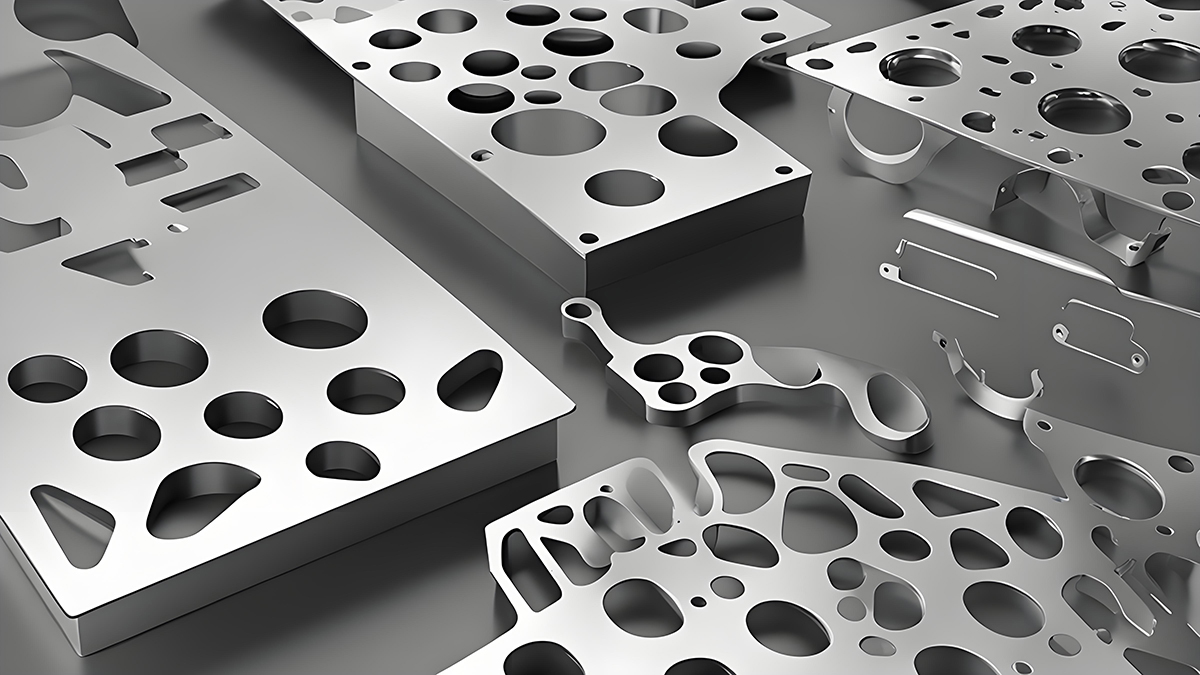
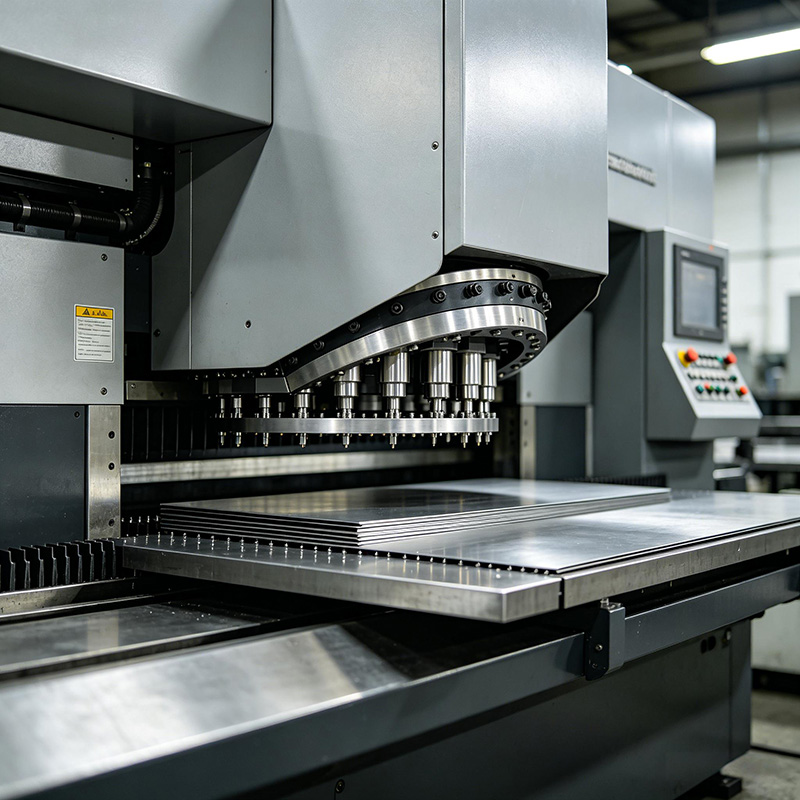
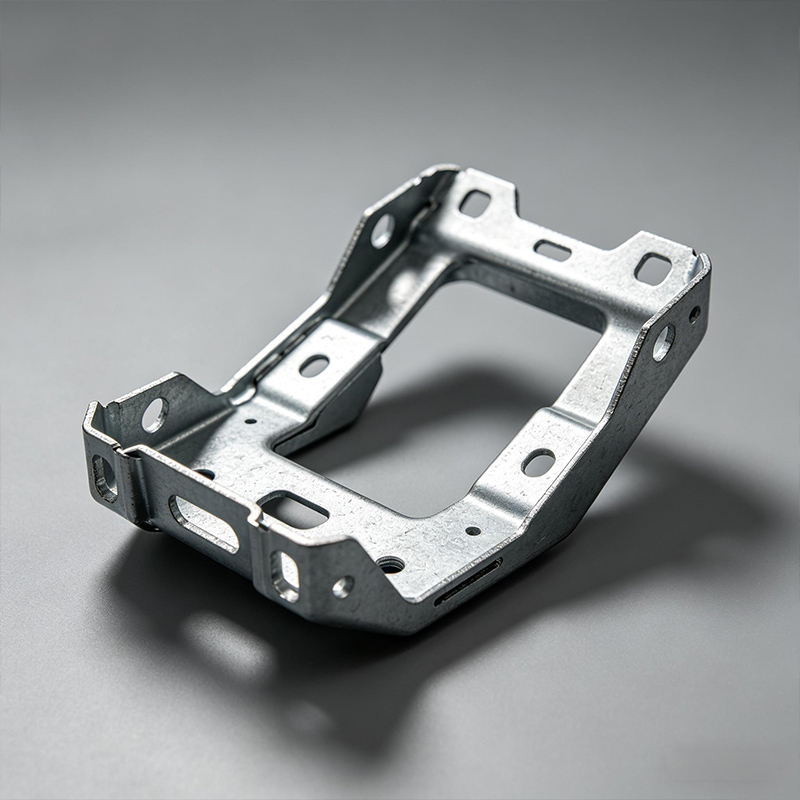
Sheet metal punching is a cold mechanical shearing process used to create holes, slots, cutouts, and other shapes in metal sheets. As a popular machining method within contemporary production, it is definitely one of the most efficient and cost-effective manufacturing methods for producing custom metal parts.
In essence, the process of sheet metal punching is simple. It only includes a punch (a tool with a specific shape) and a die (a matching cavity). The metal sheet is placed between them. The punch drives downward into the die with controlled force, shearing the material and creating a clean opening. The piece of metal that is removed is called a slug, which is typically recycled as scrap.
Modern punching is almost entirely automated using CNC (Computer Numerical Control) technology. A CNC punch press can be programmed to follow precise coordinates, reposition the sheet automatically, and even switch between different punch shapes without manual intervention. This is what makes punching so suitable for custom parts.
What Materials Can Be Punched?
The sheet metal punching process works with a wide range of metals. The most common include:
| Material | Characteristics | Max Thickness (Metric) |
|---|---|---|
| Mild Steel | Excellent punchability | 6 mm |
| Stainless Steel | Requires more force and lubrication | 4.7 mm |
| Aluminum | Soft and easy to punch | 6 mm |
| Copper & Brass | Soft metals; excellent hole quality | 3 mm |
Remember: The minimum hole diameter should be at least equal to the material thickness. For example, punching a 2 mm hole in a 3 mm steel sheet is difficult and may cause tool breakage or deformation.
Key Punching Techniques for Custom Parts
Not all punching is the same. In fact, there are a great variety of punching techniques based on specific metal forming operations, and which to apply depends on your design. So, what are the differences between different punching techniques?
| Technique | What It Does | Best For |
|---|---|---|
| Single Punching | One stroke creates one hole or shape | Simple designs, low-volume production, prototypes |
| Multiple Punching | Several punches strike simultaneously | Repetitive patterns, high-volume runs |
| Piercing | Cutting a hole of the desired shape through the sheet | Fastener holes |
| Notching | Cutting out material from an edge or corner | Tab/fit features |
| Blanking | Removal of a complete piece from the sheet | Washers, parts |
| Lancing | Partial cut, leaving a tab or lip | Standoffs, vents |
| Nibbling | Overlapping small punches trace a contour | Irregular shapes, custom contours without special tooling |
| Slotting | Creating a long rectangular or oval opening. | Wiring, tabs |
| Perforating | Creating a grid or pattern of holes | Ventilation panels, filters, decorative screens |
| Embossing | Forming raised or recessed details without piercing | Logos, labels, strengthening ribs |
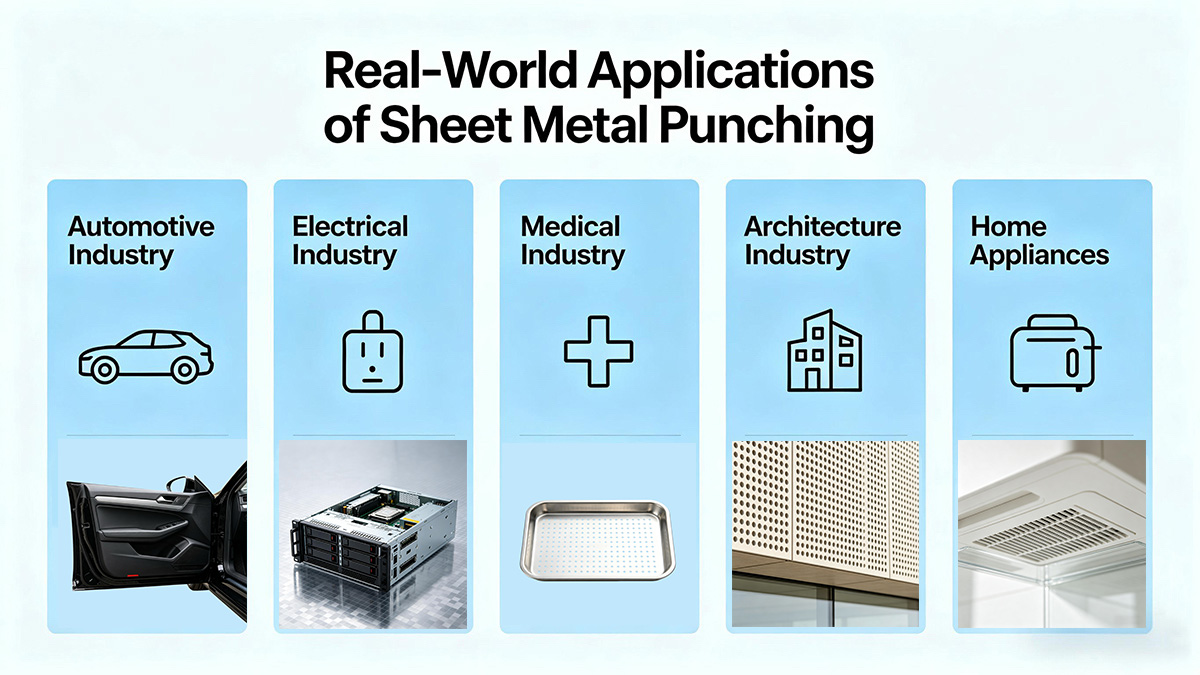
Real-World Applications of Sheet Metal Punching
As a versatile method, sheet metal punching is used in the manufacturing of many products in various industries. Here are some examples:
- Automotive Industry: Seat frame brackets, heat shields, door panels, engine covers, clip & rivet holes, etc.
- Electrical Industry: Server chassis, faceplates, perforated panels, cutouts for connectors, panel brackets, etc.
- Medical Industry: Perforated trays, catheter components, pins, etc.
- Architecture Industry: Perforated façade panels, acoustic panels, claddings, aesthetic parts, etc.
- Home Appliances: Ventilation slots, wall mounting brackets, louvered panels, hinges, shelves and other furniture components
Advantages of Sheet Metal Punching
What makes punching better than other methods? Let’s take a look at the key benefits of it:
- Speed: A CNC turret punch press can deliver 400 to 1,600 strokes per minute, much faster than other methods. The high efficiency of sheet metal punching makes it suitable for mass production.
- Cost-Effectiveness: Although the cost of punching tools is relatively high, once the tooling is set up, the follow-up cost is very low. In addition, punching consumes less energy than other methods and produces minimal waste.
- Consistency and Accuracy: CNC punching achieves tolerances of ±0.005″ (0.127 mm) on hole-to-hole dimensions. Every part in a production run is identical to the first.
- Versatility: You can punch mild steel, stainless steel, aluminum, copper, titanium, and many other metal sheets, and you can create many different shapes and sizes such as round holes, square openings, slots, and embossed logos using one single punching machine.
- No Heat-Affected Zone: Unlike other methods such as laser cutting, punching is a mechanical process. It does not melt or vaporize material, so there is no heat discoloration or micro-cracking along the cut edge.
Limitations of Sheet Metal Punching
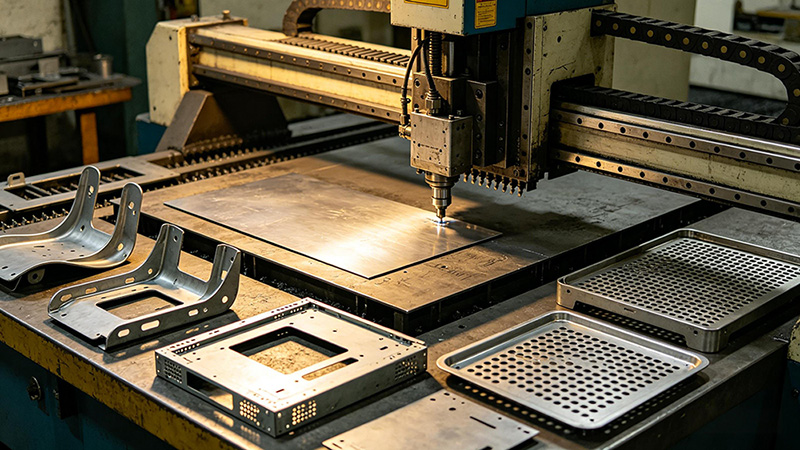
Honestly speaking, versatile as it is, punching isn’t perfect for every situation. It also suffers from several drawbacks, such as:
- High Tooling Investment: Custom punch and die sets require high upfront costs (typically $1,000–$10,000). This makes punching less cost-effective for low-volume manufacturing or one-off prototypes.
- Safety Concerns: The punching process can be extremely dangerous and lead to serious accidents due to improper operation. It is essential for operators to receive thorough training before work and stick to the safety guidelines when operating machines.
- Noise: The process of punching can create constant deafening noises exceeding 85 dB(A), which may bring about operators’ hearing loss or damage.
- Material Distortion: Thin or soft materials may warp around punched features if clearances or tooling is not optimized.
Common Punching Defects and How to Remedy Them
Here are the most common punching defects and their solutions. Use these methods to identify defects and fix them as quickly as possible.
| Defect | Problem | Cause | Solution |
|---|---|---|---|
| Burrs | Sharp edges remaining on the workpiece | Dull tooling or excessive clearance | Sharpen the punch and reduce clearance |
| Rollover | Rounded or deformed entry edge on the hole | Large clearance or use of softer materials | Adjust tool geometry and select appropriate clearance values |
| Pulled slugs | Slugs sticking to the punch or falling back into the hole | Poor slug control or weak ejection mechanism | Improve the ejection system and optimize die design |
| Cracking | Cracks forming around the hole edge | Brittle material or incorrect punch edge radius | Use a suitable punch radius and verify material compatibility |
| Warping | Bent or uneven sheet surface | Inadequate clamping or excessive punching force | Enhance fixturing and adjust punching force as needed |
Conclusion
In conclusion, sheet metal punching is a versatile and efficient manufacturing method that can be employed to make a broad range of products in different industries.
As an experienced and trustworthy sheet metal fabricator, KingStar specializes in producing high-quality sheet metal parts using advanced CNC turret punching technology and punch form tooling. We adhere to Design for Manufacturability (DFM) principles and follow rigorous quality control procedures to ensure that every part meets your requirements. Feel free to contact us at sales@kingstarmold.com for more information and to address your needs.

Boasts more than 20 years of professional experience in the manufacturing industry, with profound expertise in injection molding and mold building. Possesses comprehensive technical capabilities covering mold design, processing and molding optimization, providing reliable technical support for product development and production.